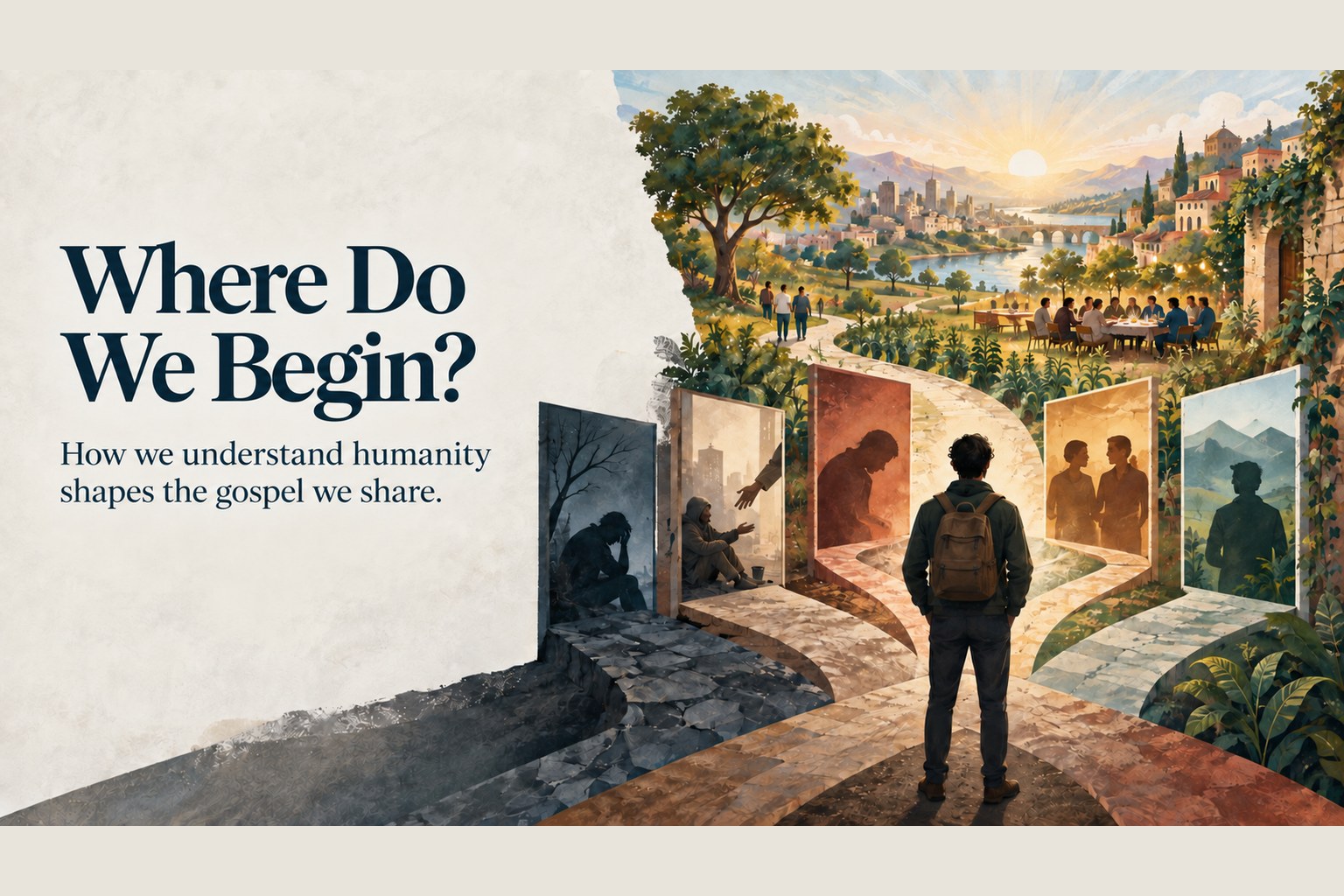
Where Do We Begin?
How we understand humanity shapes the gospel we share.

God created humankind in his own image, in the image of God he created them, male and female he created them.
God created man in his own image. In God’s image he created him; male and female he created them.
Read aloud by your device, not by Denvil.
Text size
Reading speed
Follow along
The sentence being read is marked, and the page moves to it when it goes off screen.
Keep the screen on
While it is reading. Some phones still lock on their own, and the voice stops when they do.
Tap a sentence to mark it. Tap it again to take the mark off. Saved on this device.
Several weeks ago, I spent a Sunday afternoon watching clips of well-known Christian influencers walking around college campuses and local community events, sharing the gospel with strangers.
(My intention was to learn from the ways younger Christians share the gospel with their peers and, perhaps even more importantly, to learn more about how our culture responds to the gospel.)
As I watched, I noticed that many of them began by asking some form of the same sobering diagnostic question: “What do you think would happen if you died tomorrow?”
Others asked whether the person would allow someone they did not know into their home. Heaven, they explained, is God’s home, and if we want to enter it, we need a relationship with Him.
Each approach offered a doorway into the gospel, and each doorway began with something true about the human condition.
Some began with death, asking, “If you died tonight, where would you go?” That is the question whole generations learned from D. James Kennedy’s Evangelism Explosion.1 And indeed, death is an enemy, and the resurrection of Jesus offers hope beyond the grave.
Others started with guilt: “Have you broken God’s law?” That is the approach Ray Comfort’s Way of the Master has made familiar. And indeed, guilt is real, and through Jesus the guilty can be forgiven.
Some appealed to relationship, as in the Navigators’ Bridge to Life, which emphasizes that sin has separated us from God, while others began with divine purpose, “God has a plan for your life,” echoing Cru’s Four Spiritual Laws. And indeed, we were made for relationship with God, and our lives do have a purpose within His world.
Each starting point is a real doorway, built by people who wanted strangers to meet Jesus, and it can leave an impression that outlasts the conversation.
Personally, in the church circles I have been most closely associated with, people often begin with need as the entry point: Are you hurting? Can we pray for you? Do you need healing? Can we share something we sense God saying?
Admittedly, I have always been drawn to this approach, even though it can feel more awkward and risky. Human brokenness shows up everywhere, which means a gospel conversation can begin almost anywhere. Beginning with need asks us to pay attention to the person in front of us, to care about their lived experience, and to depend on the Holy Spirit to recognize where God may already be at work.
But this approach carries its own danger too.
If we begin with death, we can start seeing people primarily as souls who need somewhere to go. If we begin with guilt, we can see them primarily as lawbreakers who need their records cleared. If we begin with separation, we can see them as strangers who need access. If we begin with purpose, we can see them as people searching for a better plan. And if we begin with need, as I often do, we can see them primarily through their sickness, pain, addiction, loneliness, or trauma.
Every starting point carries an implicit understanding of humanity within it. It tells us what we think is most important about the person, what we believe has gone wrong, and what we think God wants to do for them. When that vision becomes too small, evangelism can quietly become something we do to people rather than a way of participating in God’s love for them.
This is why our conversational starting point and our theological starting point cannot be the same in every situation for every person.
Love requires us to meet people where they are, so a conversation may begin with death, guilt, separation, purpose, or need. But our heart posture must begin somewhere deeper. Before the person in front of us is a sinner to be forgiven, a stranger to be reconciled, a soul facing death, or a wounded person in need of healing, they are someone God made in His image. Their brokenness may tell us where the conversation begins, but it does not tell us who they are or where they began.
As our geometry teachers taught us, we can draw a line beginning at almost any point. But when it comes to sharing the gospel, we benefit most from starting where the Spirit is pointing.
The Spirit may direct us toward the need that is most visible in the moment, but He teaches us to see the person through God’s intention from the beginning.
Still, I recognize that the place where a gospel conversation begins can quietly become the whole gospel we tell.
Every Gospel Starts Somewhere
The goal of sharing the gospel remains the same: to invite people to respond to the good news by surrendering their lives to the lordship of Jesus.2 Yet, as one of my pastors has often said, our evangelism can quickly become our discipleship. How we explain what someone is being saved from, and what they are being saved for, shapes the Christian life they expect to live afterward.
It also shapes how we see the person standing in front of us. Our starting point can quietly train us to see someone primarily as a soul facing death, a lawbreaker carrying guilt, a stranger seeking access, or a wounded person needing relief.
Scot McKnight raises a related concern in The King Jesus Gospel,3 explaining that we can reduce the announcement about Jesus to a message about our personal salvation.
If we begin with death, salvation can become primarily about where we go after we die.
If someone responds to the gospel out of guilt, salvation can become primarily about having their record cleared.
If we begin with access to God’s dwelling place, salvation can become permission to enter heaven.
If we begin with need, salvation can become relief from whatever is hurting today.
Dallas Willard had a name for good news that shrinks like this: gospels of sin management, sized to the problem they solve and no larger.4 We can become so focused on dealing with sin and its consequences that the life Jesus invites us to live barely enters the conversation.
Please note, none of the effects of sin are insignificant. Death is still an enemy Jesus defeats. Guilt can be forgiven, and estranged people can be reconciled to God through Him. Suffering still matters deeply to God, and so Jesus is present among the hurting, and He heals, provides, delivers, and restores.
Every gospel presentation names something we need to be saved from, but the Kingdom of God that Jesus preached also announces the life we are being restored for. If we begin and end with what has gone wrong, our vision of both salvation and the person can shrink. We may accurately name their condition while failing to see their God-given identity.
That is why I have found myself returning to the beginning.
Genesis 1 and 2 Come Before Genesis 3
Genesis 1 and Genesis 2 come before Genesis 3. That sounds obvious, but maybe that order matters more than we think. Before Scripture tells us what went wrong with humanity, it tells us who we are.
“So God created mankind in his own image, in the image of God he created them; male and female he created them”
God created humankind in his own image, in the image of God he created them, male and female he created them.
God created man in his own image. In God’s image he created him; male and female he created them.
Sometimes we have learned to tell the Christian story from Genesis 3, as though the first meaningful thing the Bible says about humanity is that we sinned. The issue is not merely that this leaves something out. It begins the human story somewhere God does not begin.
Before sin in , there is goodness in .
When the woman saw that the tree produced fruit that was good for food, was attractive to the eye, and was desirable for making one wise, she took some of its fruit and ate it. She also gave some of it to her husband who was with her, and he ate it.
Genesis 3:6 NET
God saw all that he had made—and it was very good! There was evening, and there was morning, the sixth day.
Genesis 1:31 NET
Before we saw judgment in , there is blessing in .
The Lord God said to the serpent, “Because you have done this, cursed are you above all the cattle and all the living creatures of the field! On your belly you will crawl and dust you will eat all the days of your life. And I will put hostility between you and the woman and between your offspring and her offspring; he will strike your head, and you will strike his heel.” To the woman he said, “I will greatly increase your labor pains; with pain you will give birth to children. You will want to control your husband, but he will dominate you.” But to Adam he said, “Because you obeyed your wife and ate from the tree about which I commanded you, ‘You must not eat from it,’ the ground is cursed because of you; in painful toil you will eat of it all the days of your life. It will produce thorns and thistles for you, but you will eat the grain of the field. By the sweat of your brow you will eat food until you return to the ground, for out of it you were taken; for you are dust, and to dust you will return.”
Genesis 3:14-19 NET
God blessed them and said to them, “Be fruitful and multiply! Fill the earth and subdue it! Rule over the fish of the sea and the birds of the air and every creature that moves on the ground.”
Genesis 1:28 NET
Before separation in , there is presence in .
So the Lord God expelled him from the orchard in Eden to cultivate the ground from which he had been taken. When he drove the man out, he placed on the eastern side of the orchard in Eden angelic sentries who used the flame of a whirling sword to guard the way to the tree of life.
Genesis 3:23-24 NET
The Lord God took the man and placed him in the orchard in Eden to care for it and to maintain it. Then the Lord God commanded the man, “You may freely eat fruit from every tree of the orchard, but you must not eat from the tree of the knowledge of good and evil, for when you eat from it you will surely die.” The Lord God said, “It is not good for the man to be alone. I will make a companion for him who corresponds to him.” The Lord God formed out of the ground every living animal of the field and every bird of the air. He brought them to the man to see what he would name them, and whatever the man called each living creature, that was its name. So the man named all the animals, the birds of the air, and the living creatures of the field, but for Adam no companion who corresponded to him was found. So the Lord God caused the man to fall into a deep sleep, and while he was asleep, he took part of the man’s side and closed up the place with flesh. Then the Lord God made a woman from the part he had taken out of the man, and he brought her to the man.
Genesis 2:15-22 NET
Before humanity fails, they are given an identity, placed in relationship, entrusted with purpose, and given a world to care for.
Now, I can already hear the concern. Doesn’t starting with creation go soft on sin? But it does the opposite. If sin is the first and deepest truth we know about humanity, people will appear to us primarily as guilty problems in need of a solution. But when Genesis 1 and 2 tell us what humanity is before Genesis 3 tells us what happened to humanity, even our understanding of sin changes. Sin remains devastating, but we recognize it as the distortion of something God made good; the sin people experience, whether it is happening to them or through them, is tragic precisely because something good has been fractured.
To cultivate a heart for people that resembles the heart of Jesus, we must practice seeing them as Scripture first sees them. We are God’s image before we do anything for God. We do not earn that identity through usefulness or moral performance. We receive it from God. From that identity comes our vocation: to reflect His character, represent His reign5, and live in relationship with Him and one another.
While I use Genesis 1 and 2 to emphasize this point, it is not the last word Scripture speaks about that image. After the flood, God still grounds the protection of human life in His own image (), and in the New Testament, James can still say that the people we curse were made in God’s likeness (). The image of God remains, on both sides of the fall. Whoever stands in front of us, whether they know Jesus or not, has been made in the image of God, not in the image of sin. That is the soil from which our understanding of human dignity, sin, salvation, discipleship, and mission must grow.
“Whoever sheds human blood, by other humans must his blood be shed; for in God’s image God has made humankind.
Genesis 9:6 NET
With it we bless the Lord and Father, and with it we curse people made in God’s image.
James 3:9 NET
After the Fall, the image of God remains on every human. Specifically, it is our lives and vocation as image-bearers that have become disordered. Because of sin in the world, we no longer represent God faithfully and our relationships with God, with one another, and with our bodies, our work, and creation all fracture. The problem is not simply that guilty people need their records cleared. It is that God’s good world and God’s beloved image-bearers are no longer living in harmony with His intention.
Need Is a Doorway, Not an Identity
None of this means every gospel conversation must begin with a lesson on Genesis 1.
When someone is sick, we may begin with the sickness. When someone is grieving, we may begin with the loss. When someone is trapped in addiction, we may begin with the bondage. When someone is carrying guilt, we may begin with forgiveness. When someone has been shamed by what another person did to them, we may begin by helping them know they are seen and loved. That is not a theological compromise. It is love. We meet people where they are, just as Jesus so often did.
But the starting point of the conversation and its controlling vision are not the same thing. Need may be where ministry begins, but it is not where the human story begins, and we cannot allow a person’s brokenness to become our definition of them. The person in front of us is not fundamentally a problem to be solved. They are someone God made, someone who bears His image, someone whose life has intention behind it. The need gives us a point of contact, but it is God’s good intention that gives us the horizon we pray toward.
In this view, what guides us is a vision of human flourishing rooted in God’s intention: people living in His presence, loving one another, caring for His world, and faithfully carrying the responsibilities He has entrusted to them. That life includes repentance, costly love, and learning to follow Jesus even when suffering remains. It is the life we were made for.
The Gospel Is Larger Than Access
Returning to the beginning also changes the way we talk about heaven.
The home illustration I heard in those videos treats salvation as a question of access. In that view, heaven is presented as a distant place where God lives, and because we are strangers or sinners, we cannot enter unless Jesus lets us in. But I wonder what that illustration leaves us imagining about the life God wants to share with us.
I am slow to describe heaven simply as a distant place where God now lives, or as a distant future that people die and get into. Even now, before the end, Scripture speaks of God dwelling among His people through the Spirit (). The Bible describes heaven as the realm of God’s presence and reign,6 and Jesus announced that God’s Kingdom had come near and was already breaking into the present. So describing heaven only in terms of God’s distant home risks obscuring the good news of how near the Kingdom has come in Christ. And the biblical story does not end with us leaving for somewhere else. It ends with God making His home among humanity in a new heaven and a new earth.
in whom you also are being built together into a dwelling place of God in the Spirit.
Ephesians 2:22 NET
“Look! God’s dwelling place is now among the people, and he will dwell with them”
And I heard a loud voice from the throne saying: “Look! The residence of God is among human beings. He will live among them, and they will be his people, and God himself will be with them.
I heard a loud voice out of heaven saying, “Behold, God’s dwelling is with people, and he will dwell with them, and they will be his people, and God himself will be with them as their God.
The good news of evangelism is that in Jesus, God steps into the human condition. He takes on a body, enters our suffering, bears our sin, defeats our death, and rises bodily from the grave. And His resurrection is not merely evidence that He can take us somewhere else after we die; it is the beginning of the end of everything that opposes God’s good intention.
It is indeed good news that God’s future began when Jesus rose and not when we die.
Paul calls the risen Jesus “the firstfruits of those who have fallen asleep” (1 Corinthians 15:20, NIV), the first portion of a harvest that is still coming. Jesus’ bodily resurrection tells us something about what God intends to restore. While salvation includes forgiveness and rescue from judgment, it also reaches toward a restored human life in renewed creation. In Jesus, the true human, and through the Holy Spirit, God restores us to life with Him and one another, with bodies and a world that still matters. Christ restores human beings to faithful participation in God’s purposes for creation, what we glimpsed in Genesis 1 and 2.
Signs of the World God Is Restoring
This is why Jesus announced the gospel by saying, “The kingdom of God has come near. Repent and believe the good news!” (Mark 1:15, NIV).
God’s reign has come near in Jesus, and through the Holy Spirit the life of that coming Kingdom is already becoming present among us. This is why the church prays for healing, welcomes the lonely, serves the vulnerable, confronts injustice, and announces forgiveness in Jesus because sickness, isolation, exploitation, and sin do not belong to His promised future. Through love, service, and the gifts of the Spirit, the church participates in what Jesus has begun, announcing the good news and inviting people to repent, trust Him, and live under His rulership.
Of course, not every sickness is healed today, and not every broken thing immediately becomes whole. The Kingdom is already present, but it has not yet come in its fullness.7
We live and minister in the tension between what Jesus has begun and what only Jesus will complete. So in sharing the gospel, we keep praying with expectation, and we keep loving and accompanying people when the healing we hoped for has not come.
I also find myself thinking about people whose ordinary way of being with others embodies this kind of Kingdom evangelism. Fred Rogers comes to mind, with his patient attention to children and their feelings. His ministry reached children and families through television.8 I think, too, of Henri Nouwen and his invitation to receive our belovedness as a gift from God.9 What draws me to them is the way attention, gentleness, and presence can help another person experience something of the love we proclaim. The gospel is not only something we explain. It is a reality we learn to inhabit in the presence of others.
Where Does Your Gospel Begin?
So, where does your gospel begin?
Maybe it begins with death, or guilt, or a longing for relationship, or a need that only God can meet. Any of those places can become a doorway, but none of them is the whole house.
The good news centers on Jesus: the crucified and risen King through whom God’s Kingdom has come near. Genesis gives us the beginning of the story that helps us understand what He has come to restore. We might begin a conversation with what has gone wrong in someone’s life, but our conviction about that person must reach back to what God intended from the beginning.
The church’s definition of salvation can become thin when its definition of humanity becomes thin first. When we recover a fuller vision of what it means to be human, we begin to see how much the good news holds together.
Forgiveness restores us to relationship with God.
Healing gives us a sign of the coming Kingdom.
Discipleship forms us to follow Jesus and live faithfully as His image-bearers.
And the church becomes a people learning that life together, awaiting bodily resurrection and a world made new.
That is not a different gospel. It is the same gospel with the whole story attached.
Yes, we must address what has gone wrong with humanity. But first, we must remember who humanity was created to be.
A note on sources.
The conviction that salvation in the New Testament is carried by many images rather than one is worked out at book length in Brenda B. Colijn, Images of Salvation in the New Testament (IVP Academic, 2010). Scripture quoted in the body of this essay is from the New International Version; a passage opened from a reference on this page is shown in the NET, WEB, or NLT, credited below. Scripture quotations taken from The Holy Bible, New International Version® NIV® Copyright © 1973 1978 1984 2011 by Biblica, Inc.™ Used by permission. All rights reserved worldwide.
Footnotes
-
Evangelism Explosion, founded by D. James Kennedy in 1962; its diagnostic questions are published at evangelismexplosion.org/2025/08/21/a-conversation-about-heaven. Way of the Master was founded by Ray Comfort and Kirk Cameron in 2002; its own presentation of the question is at livingwaters.com/are-you-a-good-person. The Bridge to Life is published by the Navigators at navigators.org/resource/the-bridge-to-life. The booklet The Four Spiritual Laws was written by Bill Bright for Campus Crusade for Christ, now Cru, in 1965; Cru tells its history at cru.org. ↩
-
On salvation as allegiance to Jesus as King, see Matthew W. Bates, Salvation by Allegiance Alone (Baker Academic, 2017). ↩
-
Scot McKnight, The King Jesus Gospel: The Original Good News Revisited (Zondervan, 2011), at zondervanacademic.com. McKnight argues that the plan of salvation emerges from the gospel story but is not itself the gospel. ↩
-
Dallas Willard, The Divine Conspiracy, chapter 2, “Gospels of Sin Management.” He makes the same argument in “Renewed for Mission,” at dwillard.org/resources/articles/renewed-for-mission. ↩
-
On the image of God as royal representation, see J. Richard Middleton, The Liberating Image: The Imago Dei in Genesis 1 (Brazos, 2005). ↩
-
N. T. Wright makes this argument at length in Surprised by Hope (HarperOne, 2008); many of his lectures on resurrection and new creation are freely available at ntwrightpage.com. ↩
-
The already-and-not-yet frame is George Eldon Ladd’s; see The Gospel of the Kingdom (Eerdmans, 1959). ↩
-
Fred Rogers was ordained in 1962 by the United Presbyterian Church in the U.S.A., the denomination that preceded today’s Presbyterian Church (U.S.A.), with a charge to serve children and families through the media. The PC(USA) tells the story at pcusa.org, and the Synod of the Trinity at syntrinity.org/mister-rogers. ↩
-
Henri Nouwen, Life of the Beloved: Spiritual Living in a Secular World (Crossroad, 1992); free material at henrinouwen.org/books/life-of-the-beloved. ↩