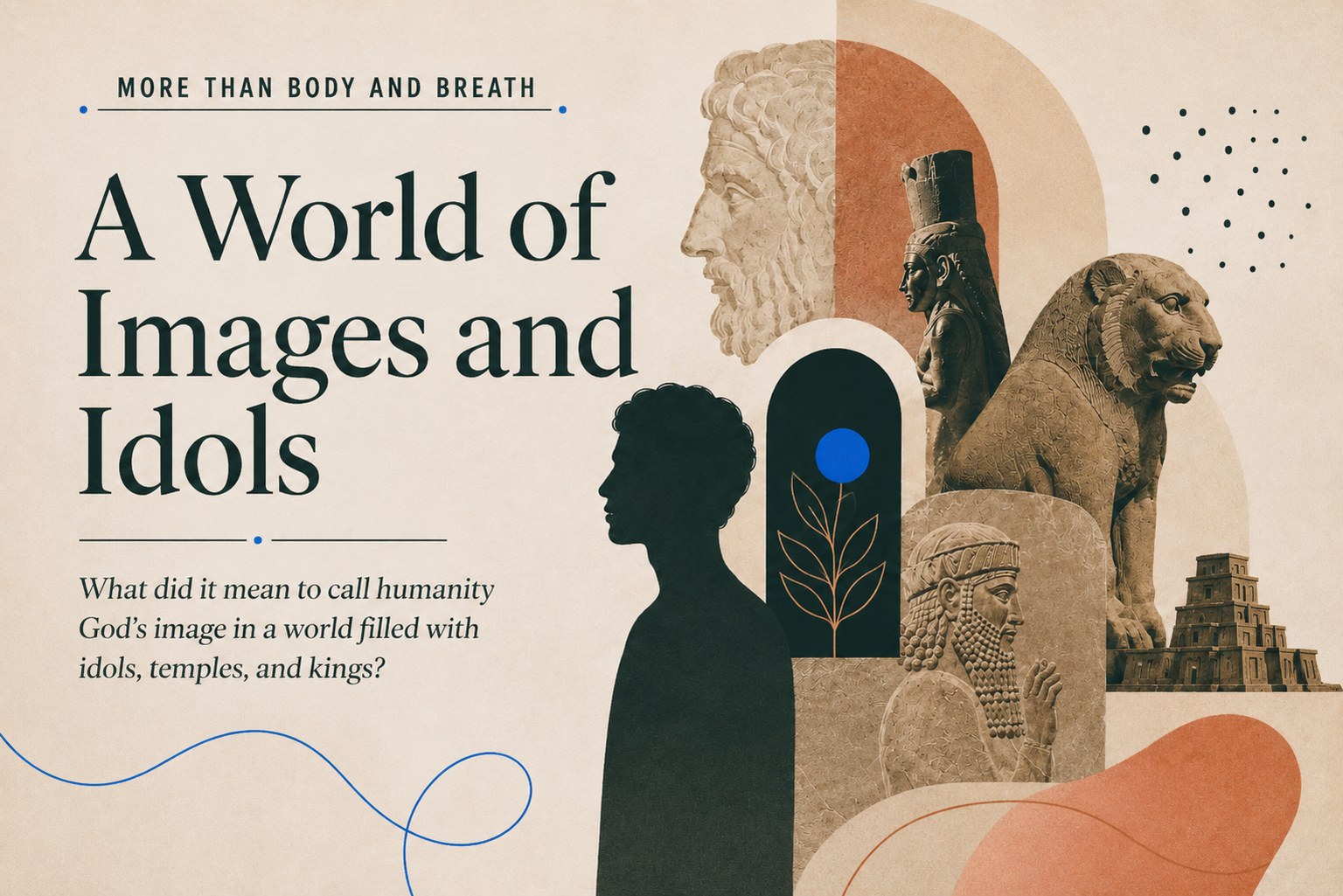
A World of Images and Idols.
What it means to bear God's image in a world of idols, temples, and kings

God created humankind in his own image, in the image of God he created them, male and female he created them.
God created man in his own image. In God’s image he created him; male and female he created them.
Loading the New Living Translation.
Read aloud by your device, not by Denvil.
Genesis says human beings are God’s image. The phrase is familiar enough that it can lose its force. But the first hearers of Genesis lived in a world already crowded with images, temples, kings, and claims about divine presence.
So what would it have meant for Genesis to say that the image of God is not locked inside a temple or reserved for the person at the top, but is carried by human beings?
That is where the claim gets much bigger.
The ancient world would have understood this image language more immediately than we do, because that world was full of images, many of which we would call idols.
A divine image was more than religious art. It represented the presence and authority of a god in a particular place. You did not approach the image simply to admire the craftsmanship. It functioned as an earthly representation of the deity.
Genesis speaks into that world and uses its vocabulary on purpose. The Hebrew word for image, tselem, is also used elsewhere in the Old Testament for carved and cast images Israel is repeatedly told to tear down (Numbers 33:52; 2 Kings 11:18; Ezekiel 7:20).
The image language was not only religious. It was also used for kings. In Egypt and Mesopotamia, kings could be described as the image of a god, living representatives of divine rule in the land. It was a kind of royal propaganda. The king stood at the top as the earthly representative of divine authority, while everybody else lived somewhere beneath him.1
And that is where Genesis becomes radically polemical.
Genesis takes language associated with gods and kings and announces:
“God created mankind in his own image.... male and female he created them”
God created humankind in his own image, in the image of God he created them, male and female he created them.
God created man in his own image. In God’s image he created him; male and female he created them.
Loading the New Living Translation.
Not only the king.
The farmer.
The slave.
The woman.
The child.
Do not move past that too quickly.
Genesis takes something the surrounding world could associate with the person at the top and distributes it across humanity. Male and female, not just the elite and powerful, are named as God’s image.
And if this is not radical enough, the imagery reaches even farther....
Old Testament scholar John Walton argues that Genesis 1 presents creation in the pattern of a cosmic temple being ordered and filled. When God “rests” on the seventh day, Walton argues, the picture is not of an exhausted God taking a break. It is the language of God taking up his rule in an ordered creation.2
N. T. Wright makes the imagery vivid and explains that temples in the ancient world were places where heaven and earth “would come together, would overlap and interlock.” And in this reading of Genesis, the final image placed within God’s cosmic temple is not a statue made of stone.... It is humanity.
That is an enormous claim.
The image in the temple represents the presence and rule of the one whose image it is.
And Genesis says:
Genesis 2 then places God’s human images in a garden that the rest of Scripture teaches us to recognize as sacred space, a place where heaven and earth meet. As the story unfolds, human beings are not simply living near that meeting place.
They are meant to become living signs of it.
God’s presence reflected into his world.
Creation’s worship offered back toward God.
His goodness and rule made visible through embodied human lives.
This is where identity begins opening toward vocation.
You are God’s living image in his world.
And if that is who you are, then we are getting very close to the second question:
What do you think you’re doing?
The language we’ll need later
There is one more piece of language I want to put in your hands before we move on, because the rest of the biblical story will keep returning to it.
Later in Israel’s history, three offices become especially important: prophet, priest, and king.
Though Genesis never calls Adam and Eve prophets, priests, or kings, their human vocation contains dimensions that later become more visible, more specialized, and eventually concentrated in those three offices.
Start with something simple.
God speaks
Genesis 1 is a world created by the word of God.
“God said....”
Again and again.
And when God creates humans, he speaks to them:
“God blessed them and said to them, ‘Be fruitful and increase in number.... fill the earth and subdue it. Rule....’”
God blessed them and said to them, “Be fruitful and multiply! Fill the earth and subdue it! Rule over the fish of the sea and the birds of the air and every creature that moves on the ground.”
God blessed them. God said to them, “Be fruitful, multiply, fill the earth, and subdue it. Have dominion over the fish of the sea, over the birds of the sky, and over every living thing that moves on the earth.”
Loading the New Living Translation.
Genesis 2 does it again. God gives the human a word to receive and obey concerning the trees of the garden (Genesis 2:16-17).
The human being is not simply alive in God’s world. The human is addressed by God and expected to respond.
Later, Israel will know people whose particular calling is to hear the word of God and speak it faithfully. God tells Moses that he will raise up a prophet and “put my words in his mouth” (Deuteronomy 18:18). Jeremiah describes it even more vividly: the Lord touches his mouth and says, “I have put my words in your mouth” (Jeremiah 1:9).
That later office helps us recognize a dimension that was already present in ordinary human life:
Hear and respond.
That is the prophetic dimension.
God dwells and blesses
Then there is the garden itself.
Genesis 2:15 says God places the human in the garden “to work it and take care of it.” The Hebrew verbs are abad and shamar: to work or serve, and to keep or guard.
Those words become important later because the Torah uses the same vocabulary for service connected to the tabernacle. The Levites are commissioned to serve and guard the sanctuary and its responsibilities (Numbers 3:7-8; 8:26; see also 18:5-7).
Genesis never calls Adam a priest.
But when you keep reading the Torah, the language begins to sound familiar.
The human serves and guards a place filled with God’s presence. Later, priests serve and guard sacred space.
And the priestly movement runs in two directions. The high priest carries the names of Israel over his heart when he enters God’s presence (Exodus 28:29), and then priests turn toward the people and speak God’s blessing over them:
“The LORD bless you and keep you; the LORD make his face shine on you....”
“‘“The Lord bless you and protect you; The Lord make his face to shine upon you, and be gracious to you;
‘Yahweh bless you, and keep you. Yahweh make his face to shine on you, and be gracious to you.
Loading the New Living Translation.
That gives us another dimension of the human vocation:
Serve and bless.
Receive life in God’s presence and carry his goodness outward.
That is the priestly dimension.
God rules
The third one requires less inference because Genesis says it directly.
God creates humanity as his image “so that they may rule” (Genesis 1:26).
Then God blesses them and entrusts his world to their care:
“Fill the earth and subdue it. Rule over the fish in the sea and the birds in the sky and over every living creature....”
God blessed them and said to them, “Be fruitful and multiply! Fill the earth and subdue it! Rule over the fish of the sea and the birds of the air and every creature that moves on the ground.”
God blessed them. God said to them, “Be fruitful, multiply, fill the earth, and subdue it. Have dominion over the fish of the sea, over the birds of the sky, and over every living thing that moves on the earth.”
Loading the New Living Translation.
Psalm 8 later sings the same human vocation back to God:
“You made them rulers over the works of your hands; you put everything under their feet”
you appoint them to rule over your creation; you have placed everything under their authority,
You make him ruler over the works of your hands. You have put all things under his feet:
Loading the New Living Translation.
Human rule is never independent rule. We do not own the world. God does.
We exercise authority under the authority of the Creator.
So the third movement is:
Rule and steward.
Receive responsibility for what belongs to God and care for it according to his purposes.
That is the kingly, or royal, dimension.
Now put the three together.
God speaks, and humans hear and respond.
God dwells with and blesses his creation, and humans serve and bless.
God rules his world, and humans rule and steward under him.
That is what I mean when I say the original human vocation contains prophetic, priestly, and kingly dimensions.
Not three titles.
Not three professions.
One human vocation, lived together.
Later, in a fractured world, those dimensions become increasingly concentrated. Prophets hear and speak the word. Priests approach sacred space and carry blessing. Kings exercise rule.
We will follow that story across the essays that come next.
For now, just keep these three movements in your hands:
We will meet them again in Israel, watch them gather faithfully in Jesus, and see what happens when Jesus pours out his Spirit on a people.
The true Image and the temple with a pulse
If Genesis gives us the first answer to the question Who do you think you are?, the New Testament brings that answer into even sharper focus in the person of Jesus.
Paul calls him “the image of the invisible God” (Colossians 1:15).
John tells us that the Word became flesh and “made his dwelling among us” (John 1:14). The language reaches back toward the tabernacle, the place where God chose to dwell in the middle of his people.
Then Jesus stands in the temple courts and says something almost impossible to miss once John explains it:
“Destroy this temple, and I will raise it again in three days.”
John adds, “the temple he had spoken of was his body” (John 2:19-21).
Jesus is not merely another person standing at the overlap of heaven and earth.
And in Jesus we finally see what faithful image-bearing looks like.
He hears and responds perfectly to the Father.
He carries the presence and blessing of God wherever he goes.
He exercises authority without domination, rules by serving, and uses power for the good of others.
Everything we have been talking about begins to come together in him.
And then Jesus does something that makes this our story, not just his.
Through his life, death, resurrection, and exaltation, he pours out the Holy Spirit on his people. Peter says that the exalted Jesus received the promised Spirit from the Father and “poured out what you now see and hear” (Acts 2:33).
Paul tells the church, “you yourselves are God’s temple and God’s Spirit dwells in your midst” (1 Corinthians 3:16).
Peter calls believers “living stones” being built together into a spiritual house (1 Peter 2:5).
The image was never erased from humanity.
But the human vocation had become disordered.
And now, in Christ and by the Spirit, restoration has begun.
That is the already of the Kingdom.
The world is not yet what it will be. Creation still groans. Bodies still break. People still hide. The fullness of God’s Kingdom has not yet filled everything.
But something has already happened.
The King has come.
The Spirit has been poured out.
God is making his home among his people again.
Which brings us back to where we started.
Who do you think you are?
You are not the sum total of what life has called you.
You are not your usefulness, your title, your productivity, your intelligence, your failures, or your successes.
You are not simply a body with a soul parked inside it, and you are not a spirit inconvenienced by a body.
And if you are in Christ, by his Spirit, you are being restored to live faithfully into that calling.
That is not something you earn on a good week or lose on a bad one.
It is who you are.
And if identity really does precede activity, then answering that first question creates another one.
Because if this is who you are....
if you were made to hear and respond....
to serve and bless....
to rule and steward....
if you were made to represent God in the world he loves....
then eventually we have to ask:
What do you think you’re doing?
That is the question I want to take up next.
Footnotes
-
See J. Richard Middleton, The Liberating Image: The Imago Dei in Genesis 1 (Grand Rapids: Brazos, 2005), especially his treatment of royal image ideology and Genesis’s extension of image-bearing to humanity as a whole. ↩
-
John H. Walton, The Lost World of Genesis One: Ancient Cosmology and the Origins Debate (Downers Grove, IL: IVP Academic, 2009); see also The Lost World of Adam and Eve (IVP Academic, 2015). For the fuller canonical argument that Eden functions as sanctuary and that the biblical story moves toward God’s presence filling creation, see G. K. Beale, The Temple and the Church’s Mission (Downers Grove, IL: IVP Academic, 2004). ↩
-
N. T. Wright, “Space, Time and History: Jesus and the Challenge of God,” St Hild Lecture, Harrogate School of Theology and Mission, January 12, 2019. Wright describes creation as a temple whose human image reflects divine presence into creation and channels creation’s worship back toward the Creator. ↩